
- For solo violin. (10mins.)
- Commissioned and premiered by Muzi Lyu.
Selected Works
Instrumental · Electroacoustic · Transdisciplinary
Recordings, sample scores, and notes on selected works.
Performance & commission enquiries- For flute, (clarinet), violin, cello, and piano (8 mins)
- Premiered by Quasars Ensemble at the 2026 Sounds of Now Vienna Festival
Program Note
Nigredo VII: Until the Water Be Made Black continues my exploration of nigredo, the blackening process in medieval alchemy. Its title draws from the Rosarium Philosophorum: “decoct it continuously, till the water be made black.” Here, blackness marks a state of putrefaction in which water thickens, matter loses its former identity, and existing forms are dissolved before something else can emerge.
Compared with other works in the Nigredo series, this work focuses closely on a state in which something at once old and new emerges in the sparkling, boiling substance.
Different timbres behave as substances held within a single vessel, seeping into one another, accumulating as residue, then returning in altered states. Moments of fragile clarity are gradually clouded by friction, pressure, and saturation, while motion repeatedly sinks towards suspension. Nigredo appears here neither as an endpoint nor simply as an image of darkness, but as a prolonged state of becoming, where identities lose their boundaries, movement turns into sediment, and within blackness, the possibility of another form begins to gather.
- For violin, cello, and piano (9 mins)
- Premiered at the 2026 Tuckamore Festival, then by Trio Kanon in Italy
- For string quartet (7 mins)
- Premiered by Quatuor Mémoire
- Finalist, 4th MusicON International Composition Competition, 2026
Program Note
Nigredo V: Black Sun Escape is the 5th work in the Nigredo series.
In alchemical thought, Nigredo refers to the stage of blackening: a process of decomposition, dissolution, and descent in which structures lose coherence and meaning collapses into obscurity. Yet this darkness is not understood as an ending, but as a necessary condition for transformation, a passage through disintegration before the possibility of renewal can emerge.
This work draws upon the occult image of the Black Sun, treating darkness not merely as absence, but as an active and paradoxical force. The Black Sun becomes a center of gravitational tension: at once devouring and generative, silent and incandescent. Throughout the piece, sound is repeatedly pulled toward zones of collapse, saturation, and instability, only to recoil, fracture, or reassemble in altered forms.
The notion of “escape” in the title does not imply a simple departure from darkness. Rather, it suggests an attempt to move through the interior gravity of the Black Sun itself, to search, within cycles of rupture, suspension, and distortion, for a fragile opening beyond dissolution.
As the fifth installment of the Nigredo series, this work continues an exploration of shadow, decay, and transformation, while placing particular emphasis on escape as an existential process: not the rejection of darkness, but the attempt to survive its center.
- For clarinet, oboe, alto saxophone, bassoon, and bass clarinet (5 mins)
- Premiered by 5ilience Ensemble
Program Note
Nigredo IV: Noonday Demon is part of the ongoing Nigredo cycle, a series centered on states of spiritual corrosion, psychic fragmentation, and transformative darkness derived from alchemical and occult symbolism.
The title refers to the medieval concept of the Noonday Demon (daemonium meridianum), a figure associated with spiritual exhaustion, inner paralysis, and a destructive form of emptiness that arrives not in the night, but under the exposure of daylight, where you won't see it coming. In monastic writings, particularly those surrounding acedia, the noonday demon represents a condition in which time slows, meaning deteriorates, and consciousness becomes trapped between agitation and inertia.
Within the work, this figure is not treated narratively, but as a psychological and sonic atmosphere. Materials repeatedly stagnate, erode, and overextend themselves; moments of violent density collapse into suspended stillness, while unstable repetitions create the sensation of circular entrapment. Harmonic pressure, fractured resonance, and distorted continuity form a landscape in which motion itself becomes uncertain.
As the fourth work in the Nigredo series, Noonday Demon explores darkness not as obscurity, but as overexposure, a state in which illumination becomes oppressive, revealing too much and offering no escape. The work inhabits the threshold between exhaustion and breaking apart, where the self gradually dissolves beneath the weight of its own interior sun.
- Electroacoustic and transdisciplinary participatory work
- Presented at Time of Music Festival
- Electroacoustic work
Program Note
Ritual here is compressed into an extended threshold in time: drums and bells walk in place, every stroke a step that never fully crosses the line.
Fragments of prayer hover between pitch and noise, as if the mouth has begun to speak while the spirits remain silent.
The music lingers in what has “not yet” happened. Pulses gather, harmonies smear like light along the room’s edge. Trance is treated as a suspended clarity rather than a full departure, holding performers and listeners together on a narrow strip between worlds, a little longer than feels comfortable.
- For violin, saxophone, and piano
- Premiered by Off-Topic Ensemble
- For violin, saxophone, and piano
- Premiered by Off-Topic Ensemble
- For cello, accordion, and percussion
- Premiered and recorded at .abeceda Contemporary Music Festival, Slovenia
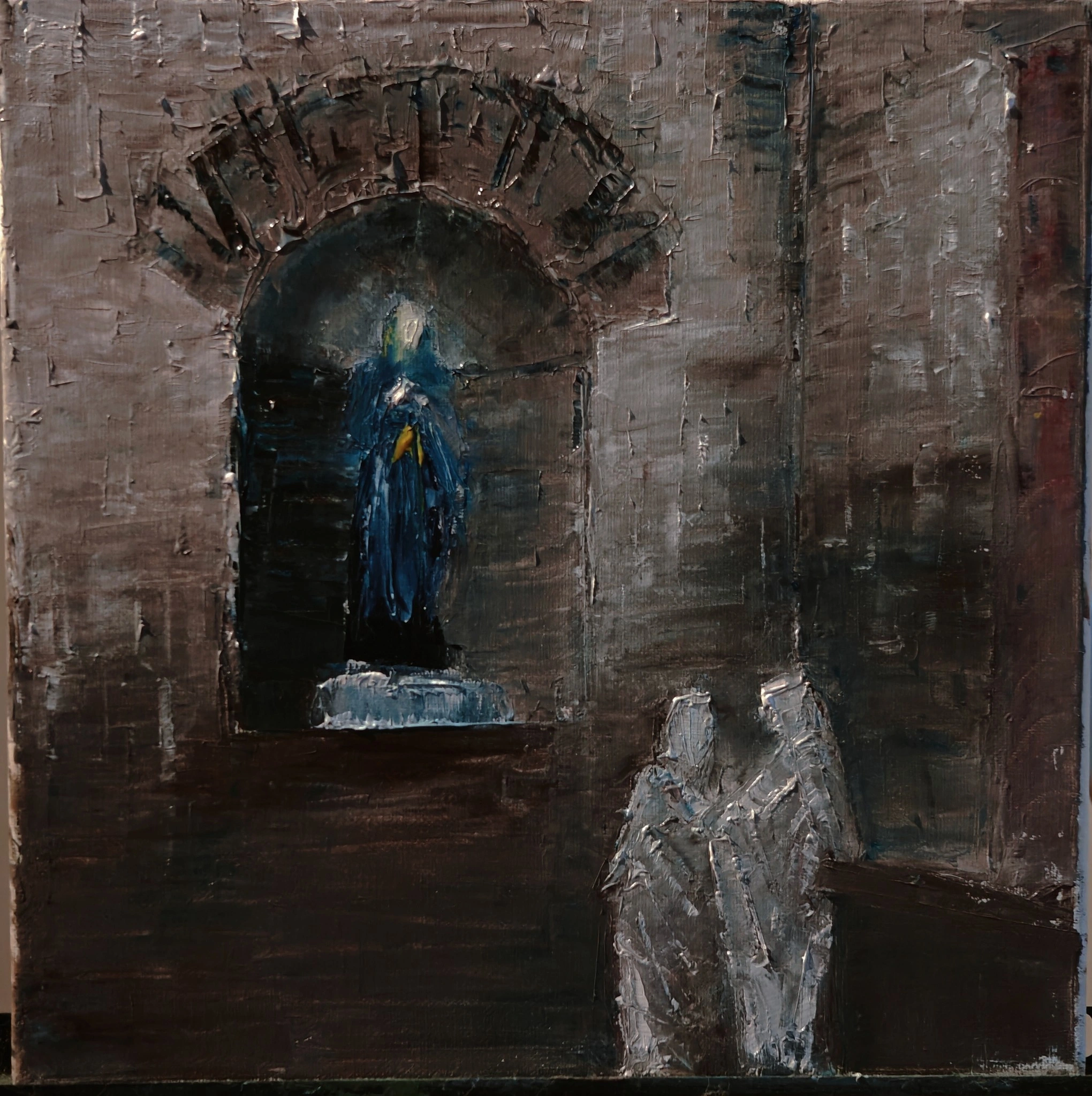
Oil Painting © 2026 Yan Liang